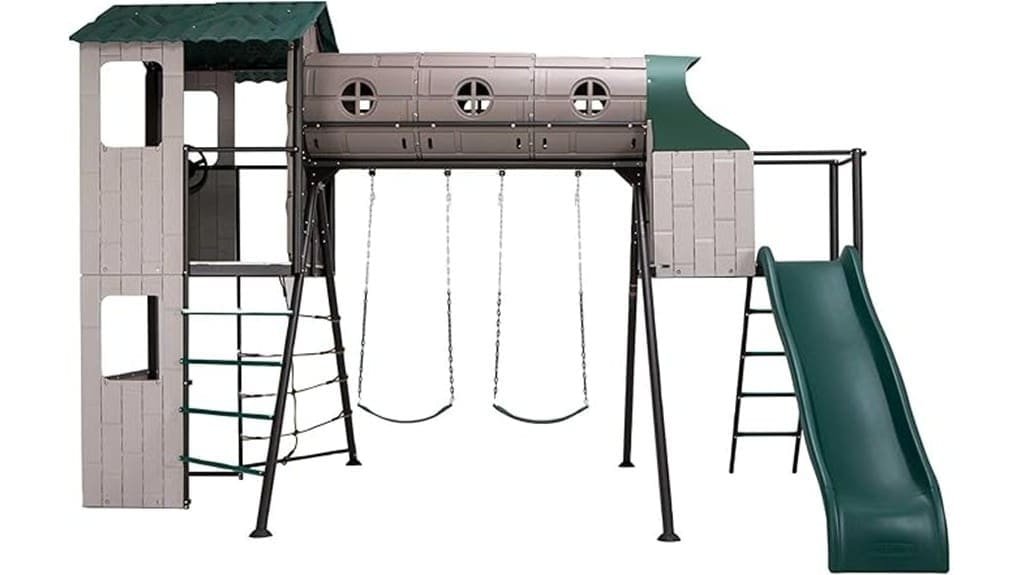

You’ll get a rugged, low-maintenance playset that’s built to last: UV-protected HDPE panels, powder-coated alloy steel, corrosion-resistant hardware, and a 1,000-pound capacity for ages 3–12. It includes a 9-foot wavy slide, six-window climbing tunnel, rope net, two ladders, three climbing walls, two belt swings, ship’s wheel and car map. Assembly’s heavy (8–12 hours, two strong adults) and it needs a large footprint, but the durability and features beat many timber alternatives—keep going for full pros, cons, and setup tips.
Some Key Takeaways
- Durable powder-coated steel and UV-protected HDPE panels resist rot, cracking, fading, and require low long-term maintenance.
- Includes 9-foot wavy slide, tunnel with six windows, rope net, two ladders, three climbing walls, and two belt swings.
- Supports up to 1,000 pounds and suits active children ages 3–12 with progressive climbing options.
- Large footprint (137″ deep × 191″ wide) and 590 lb kit require two adults and about 8–12 hours to assemble.
- Mid-to-high price point justified by durability, low maintenance, but only two swings and heavy assembly are drawbacks.
What the Lifetime Adventure Tunnel Swing Set Includes and Who It’s Best For
While it’s built for active backyard play, the Lifetime Adventure Tunnel Swing Set comes as a complete playset package: a covered clubhouse with hardtop roof and lookout, a 9-foot UV-protected wavy slide, a climbing tunnel with six windows, two belt swings with rubber-coated chains, a rope climbing net, two ladders, three climbing walls, a ship’s wheel and integrated car map for imaginative play. You’ll find the included accessories cover climbing, sliding and role-play needs, making setup more straightforward than piecing together modular kits. For the 3–12 years age range, it suits siblings sharing space and varied skill levels, offering clear activity progression. It’s particularly well-suited for homeowners who want compact, family-friendly outdoor equipment that maximizes backyard play options for children and complements outdoor spaces.
Real-World Durability and Safety: Materials, Build Quality, and Child Age/Weight Limits
Because Lifetime built this playset from UV-protected HDPE panels and powder-coated alloy steel, you can expect strong resistance to weathering—no warping, rot, cracking, or splintering that you’d get with untreated wood—and lower long-term maintenance than painted or composite options. You’ll appreciate the solid welds, corrosion-resistant hardware, and polyethylene fittings that resist fading. Material longevity outperforms typical timber sets, reducing replacement costs. Safety compliance is met with rounded edges, rubber-coated chains, and non-lead materials, and the structure supports up to 1,000 pounds total for ages 3–12. Inspect fasteners periodically and anchor per instructions for continued safe use. These durable metal playsets are ideal for homeowners looking to revamp backyard spaces for kids who enjoy their outdoor property.
Play Features Tested: Tunnel, Slide, Climbing Options, Swings, and Imaginative-Play Accessories
Jump into the testing and you’ll find the Lifetime Adventure Tunnel set balances variety and durability across its tunnel, slide, climbing options, swings, and accessories. You’ll notice the six-window tunnel creates creative hideaways and encourages sensory exploration while linking towers; it’s sturdier than thin-plastic tunnels. The 9-foot wavy HDPE slide gives a smooth, consistent run compared with budget slides. Climbing choices—rope net, two ladders, three walls—offer progressive challenge levels for ages 3–12. Two belt swings handle simultaneous play without crowding. Imaginative features like the ship’s wheel and tower car map extend role-play, rewarding group and solo sessions alike. Designed for homeowners with kids who love outdoor fun, the set pairs well with playset steering wheels and other accessories to make backyard play feel like a real adventure.
Assembly, Maintenance, and Backyard Setup Considerations (Time, Tools, Footprint)
If you’re planning installation, expect a substantial time and space commitment: the 137″ deep by 191″ wide footprint and 590 lb kit typically requires two strong adults and a full weekend (8–12 hours) for assembly with basic tools. You’ll track assembly time against clear stages: frame, towers, tunnel, slide, swings. Compare flat, level yards to sloped or restricted spaces—allow extra time for anchoring or leveling. Use a focused tool checklist: wrench set, socket set, ratchet, mallet, tape measure, ladder, drill, and safety gear. Maintenance is low: clean HDPE, touch up powder-coat chips, inspect hardware seasonally. For family backyards, plan the layout to optimize play flow and safety with sufficient fall zones and clearances around moving parts, referencing playset safety zones.
Final Verdict: Pros, Cons, Price Perspective, and Comparable Alternatives to Consider
Having covered assembly time, tools, and upkeep, let’s look at whether the Lifetime Adventure Tunnel truly earns its place in your yard. You get durable HDPE, powder-coated steel, versatile climbing features, a 9-foot slide, and a 1,000-pound capacity—clear pros for longevity and play value. Cons: heavy assembly, footprint, and only two swings. From a price comparison standpoint, it sits mid-to-high but justifies cost with low maintenance. If you want cheaper or modular options, check alternative brands like Backyard Discovery or Gorilla Playsets for timber or hybrid designs; compare warranties, materials, and included features before deciding. Many homeowners also pair these sets with zip line seats to extend backyard play options.
Some Questions Answered
Does This Set Require a Poured Concrete Anchor System?
No, you don’t need a poured concrete anchor system. You can use ground anchors provided or recommended by the manufacturer for many soil types; these screw- or stake-style anchors secure the frame without concrete. For sandy or loose soil you might prefer auger-style or deeper anchors; clay or compacted soils often hold standard screw anchors well. Compare anchor depth and type to your soil type and local wind/exposure to choose the safest option.
Are Replacement Parts Readily Available and Easy to Order?
Yes — replacement availability is strong and ordering ease is high. You’ll find Lifetime parts through the manufacturer, major retailers, and third-party suppliers; common items (swings, chains, slides, hardware kits) are stocked frequently. Compared to lesser-known brands, parts are easier to identify using model 91134 or UPC. You’ll need patience for shipping and sometimes proof of purchase, but overall you can quickly source and order needed components.
Can the Playset Be Customized With Additional Accessories?
Yes — you can customize it with add ons compatibility in mind. You’ll find limited color options for HDPE components, but many accessories like extra swings, a trapeze, or a baby bucket seat are compatible if you match mounting hardware and weight limits. Compared to modular systems, aftermarket parts may need drilling or adapter brackets. You should measure beam spacing, verify load ratings, and prefer OEM or tested third-party accessories for safety.
Is There a Warranty, and What Does It Cover?
Yes — you get a manufacturer warranty. Warranty details state Lifetime covers structural steel and some polyethylene components against defects for a limited period; Coverage specifics vary by part and typical terms include years for frame and shorter for accessories. You’ll want to compare the written warranty PDF to competitors: check exclusions (normal wear, misuse, weather damage), registration requirements, and claim process. Keep receipts and photo proof to speed any claim.
Does It Comply With Local Homeowners Association Rules?
You’ll need to check—compliance depends on neighborhood bylaws and setback requirements, not the playset itself. Measure the 191″W x 137″D footprint and confirm required distances from property lines, easements, and pools. Compare your lot dimensions and HOA rules; some allow playsets with permits, others limit height or placement. If rules are unclear, get written approval from the HOA or submit a site plan to avoid fines or required relocation.