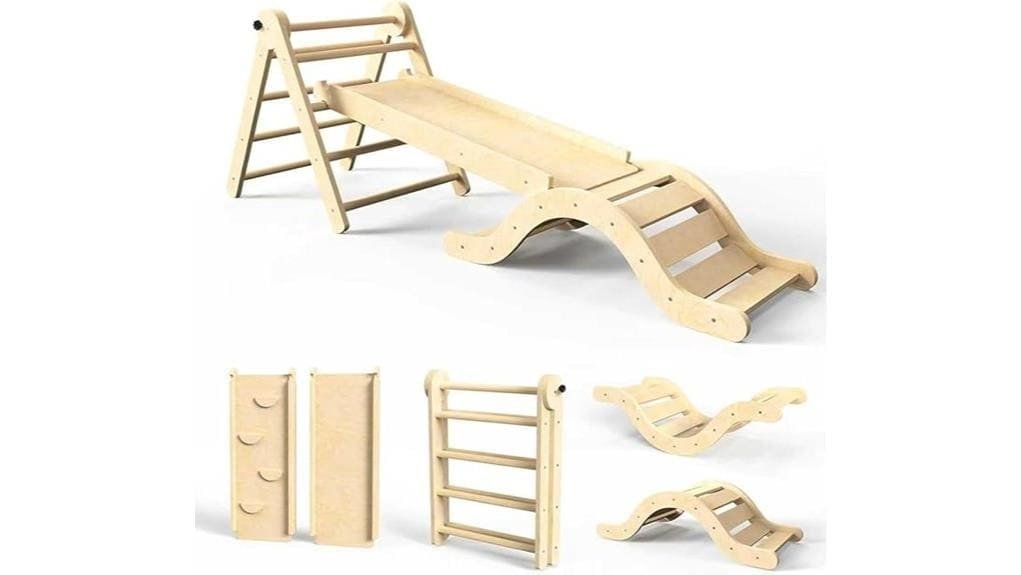

You’ll find the Doowroodni Pikler 7‑in‑1 is a solid‑birch, Montessori‑style climber that supports toddlers’ balance, coordination, and climbing milestones in adjustable configurations. It converts into a triangle, ladder, ramp/slide with handrails, arch and rock‑climb panels, and folds flat for storage. Sizes suit roughly 12–36 months and offer progressive challenges for pulling up, controlled descents and stepping. It’s durable under typical toddler loads but needs supervision and space; keep reading to see setup, safety and alternatives.
Some Key Takeaways
- Versatile 7‑in‑1 solid birch kit converts between triangle, ladder, ramp/slide, arch, and rock‑climb panels for varied toddler play.
- Best suited for ages ~12–36 months, offering adjustable difficulty for balance, coordination, and climbing milestones.
- Pre‑installed handrails, sturdy joints, and durable birch construction performed well under typical toddler loads in testing.
- Requires assembly, constant supervision, and 3–4 feet of clear, non‑slip space; not a substitute for guided therapy.
- Pros: modularity and durability; cons: age ceiling, assembly needs; compare prices and consider weatherproofing for outdoor use.
What the Doowroodni Pikler 7‑in‑1 Actually Includes and How It’s Built
Because it’s built as a modular Montessori set, the doowroodni Pikler 7‑in‑1 gives you a clear, usable kit: solid birch components that assemble into a climbing triangle, ladder, ramp/slide with pre‑installed handrails, an ergonomic arch for sitting or crawling, and rock‑climb imitation panels that together create seven play configurations. You’ll appreciate the solid construction and transparent material sourcing that favor premium birch over veneer MDF, supporting durability and safety. Foldability options let you change angles for progression and pack the set flat. Practical storage solutions reduce footprint when not in use. This design promotes motor skills, balance, and exploratory play. The set is a great fit for homeowners looking to create engaging outdoor play areas with wooden playsets.
Who It’s Best For: Age, Size, and Developmental Goals
While aimed at toddlers, the doowroodni Pikler 7‑in‑1 best serves children roughly 12–36 months old whose gross‑motor skills are developing — it gives you adjustable challenges that match a child’s progressing balance, coordination, and climbing confidence. You’ll find the medium/small sizes suit typical weight and height ranges for that window, supporting incremental practice of standing, cruising, and independent climbing. Use it to target specific motor milestones development—pulling up, controlled descents, and stair-like stepping—while promoting toddlers’ confidence in safe, graded steps. It complements Montessori play and supervised exploration rather than replacing guided skill-building or therapy. It also pairs well with other backyard playset accessories like steering wheels to extend imaginative outdoor play.
Real‑World Setup, Safety Features, and Space Needs
After picking the right size and challenge level for your toddler, plan the play area so the Pikler set sits on a flat, non-slip surface with at least 3–4 feet of clear space on all sides for safe approaches and falls; place it away from stairs, furniture with sharp corners, windows, heaters, and cords. You’ll assess room layout, set barrier-free traffic flow, and choose durable floor protection like interlocking foam or low-profile rugs. Use foldable design and compact storage solutions when not in use. Check pre-installed handrails, smooth edges, solid birch construction, and anchor points regularly to support developmental risk-taking. Follow an inspection checklist and routine maintenance schedule to keep your backyard playset safe and well-maintained, referencing playset inspection best practices.
Performance Test: How the 7‑in‑1 Modes Hold Up in Play
When you put the doowroodni Pikler Triangle Set through active play, each of the seven configurations shows clear developmental strengths and a few practical limits: the climbing ladder and rock-climb imitation reliably build leg and grip strength, the adjustable ramp and slide promote balance and vestibular control with pre-installed handrails adding measurable safety, and the arch and foldable modes encourage proprioceptive play and independent exploration in short bursts. You’ll see consistent grip performance during repeated sessions; durability testing under typical toddler loads revealed stable joints and minimal wear. Supervision remains necessary, and shift times between modes affect continuous engagement. This versatile set helps homeowners create kid-friendly outdoor adventure spaces that integrate with backyard play areas.
Buying Decision: Pros, Cons, and Alternatives to Consider
Because your toddler’s motor skills and curiosity are the main priorities, weigh the doowroodni Pikler Triangle’s developmental benefits—versatile 7‑in‑1 configurations, solid birch construction, adjustable difficulty, and built‑in handrails—against practical limits like required assembly, supervision needs, and its stated 12–36 month age range. You’ll gain proven motor skill, balance, and coordination support in a Montessori‑aligned toy. Consider price comparison to similar solid‑wood climbers and factor in long term durability of birch versus cheaper composites. Cons: setup, space, and limited age ceiling. Alternatives: modular climbers, balance beams, or convertible playsets that extend use beyond toddler years. For outdoor play areas, remember to choose rot-resistant materials and proper sealing to protect wood decks and play equipment from weather, especially when integrating playsets into a playset deck.
Some Questions Answered
Can Additional Accessories or Attachments Be Purchased Separately?
Yes — you can often buy extra accessories separately, and you’ll want to check accessory compatibility before purchasing. Look for manufacturer or seller listings that specify fittings for the Pikler triangle, ramps, slides, or climbing holds. Choose accessories that support safe developmental play, balance and coordination, and match the solid birch construction and foldable design. Keep age-appropriate size and secure attachment methods in mind for toddler safety and skill progression.
Is the Finish Non-Toxic and Safe if Mouthed?
Yes — the finish’s described materials and child-centered design suggest non toxic certification and child safe paints are used; you can expect low-toxicity, solid birch wood construction and finishes intended for mouthing. You’ll want to verify specific certification details (e.g., ASTM, EN71, or CPC) with the seller. This evidence-based approach protects development: safe finishes reduce chemical risk, letting your child explore sensorimotor skills and oral exploration confidently.
Does It Come With Replacement Parts if Damaged?
The seller doesn’t automatically include spare pieces; you’ll need to contact them for warranty inquiries and parts sourcing. You can request replacement parts through the manufacturer or distributor channels, citing damage and your child’s safety needs. They’ll guide you on returns, repair options, or buying specific components. Prioritize timely fixes so your child’s gross-motor development and safe exploration aren’t disrupted; keep receipts and photos to speed the process.
Can Adults Safely Sit or Use It for Demonstrations?
Adults shouldn’t sit on this set; adult useability is limited for safety and design. You’ll use it for demonstration safety only—briefly guiding, modeling movements, and spotting children while keeping weight off the structure. Evidence-based, child-centered practice favors using it to scaffold motor skills, demonstrate climbing technique, and supervise shifts. For developmental-focused demonstrations, stay close, use hands-on spotting, and avoid loading the frame to protect toddlers and preserve the wood.
Is There a Recommended Cleaning Method for the Wood?
Yes — you should clean it gently with a damp cloth and mild soap, then dry immediately to protect the wood. For wood care, avoid harsh chemicals and excessive water; sand any rough spots smoothly. Oiling frequency depends on use and dryness: apply a food-safe oil (like tung or mineral) every 6–12 months, or sooner if the wood looks dull or dry. This keeps surfaces safe for developmental play.